
Curso elaboración y defensa de la programación didáctica en inglés.

Las claves de nuestro éxito:
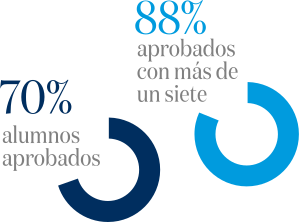
Una preparación rigurosa, centrada en la parte práctica (elaboración y defensa de la programación didáctica – preparación de la parte práctica), con profesionales con una dilata experiencia y unos resultados reconocidos, te permitirá superar oposición logrando tu plaza.
Si quieres recibir la mejor formación y ser profesor de Inglés en Enseñanza Secundaria, no dudes en contactar con nosotros y te enviaremos el enlace para la sesión informativa.
PROGRAMA DEL CURSO «ELABORACIÓN Y DEFENSA DE LA PROGRAMACIÓN DIDÁCTICA DE INGLÉS – PREPARACIÓN DEL SUPUESTO PRÁCTICO»
BLOQUE 1: INGLÉS EN SECUNDARIA Y BACHILLERATO
1.1. Inglés para Enseñanza Secundaria Obligatoria y Bachillerato en la actualidad:
retos olíneas maestras de actuación.
1.2. Marco teórico y normativo.
BLOQUE 2: “EL PAPEL DE LA PROGRAMACIÓN EN LA FASE DE OPOSICIÓN”
2.1. La aptitud pedagógica del personal aspirante y el dominio de las técnicas
necesariaspara el ejercicio de la docencia:
2.1.1. Preparación, exposición oral y defensa de una programación y unidad
didáctica.
2.2. El currículo vigente de la Comunidad Autónoma de Andalucía.
2.3. Requisitos de la programación
BLOQUE 3: LA PARTE A DE LA PRIMERA PRUEBA
3.1. Tipología de actividades. Cómo desarrollar estrategias de éxito.
3.2. Tipología textual: estructura y el lenguaje escrito.
BLOQUE 4: LA PROGRAMACIÓN PARA LA MATERIA DE INGLÉS EN SECUNDARIA Y
BACHILLERATO
4.1.Programme and units: what to expect from them and how to shape them for success.
4.2.Introduction. Justification of the Programme. Context.
4.3. Practice: Oral presentation of the programme and didactic unit.
BLOQUE 5: “CURRICULAR ELEMENTS IN THE PROGRAMME”
5.1.Objectives and competences
5.1.1.Objectives
5.1.2.Key and specific competentences
5.1.3. Connection competence-didactic programme.
5.2. Basic knowledge
5.2.1.Basic Knowledge
5.2.2. Sequencing and lesson plan.
5.2.3. Practice: Oral presentation of the didactic unit (II)


BLOQUE 6: “METHODOLOGY”
6.1. Methodology
6.1.1.Methodology: General Principles
6.1.2. Methodology: English as a Foreign Language
6.1.3. Methodology: application in activities, materials, resources, spaces, groups.
6.2. Didactic Units and Learning situations. Examples of final products. How to
present them.
6.2.1. ITC resources for learning situations.
BLOQUE 7: “CATERING FOR DIVERSITY” AND EVALUATION”
7.1. Catering for diversity
7.1.2. General specifications
7.1.3. Students with specific needs for educational support.
7.1.4. Personalized learning
7.1.5. Universal Design for Learning (UDL)
7.2. Evaluation
7.2.1 Concept and characteristics
7.2.2. Evaluation criteria
7.2.3. Evaluation tools and techniques
7.2. Conclusion
7.3. Bibliography.
7.4. Practice: Oral presentation of the didactic unit.(III)
BLOQUE 8: “COMPLEMENTARY AND EXTRACURRICULAR ACTIVITIES”
8.1. Complementary activities
8.2. Extracurricular activities
BLOQUE 9: “DIDACTIC UNITS”
9.1. Evaluation in the Didactic Unit
9.2. Didactic Units: How to shape them
BLOQUE 10: “ORAL DEFENCE OF THE PROGRAMME AND DIDACTIC UNIT”
10.1. Oral presentation of the Programme
10.2. Oral presentation of the Didactic Units
10.3. Checking the rubrics

CARACTERÍSTICAS DEL CURSO DE “ELABORACIÓN Y DEFENSA DE LA PROGRAMACIÓN DIDÁCTICA”
- Destinatarios: opositores de la especialidad de lengua extranjera inglés (SECUNDARIA)
- Duración: 9 meses.
- Modalidad: online (exposiciones finales últimos dos meses, presenciales y online).
- Recursos: todos los materiales se entregan en formato PDF, disponiendo de una INTRANET para uso particular del alumnado.
- Sesiones: 2 sesiones / mes.
- Horario: viernes de 16:30 a 20:30 (4 horas)

Perfil Preparadores
– Coordinador de la formación: Inspector de Educación.
– Preparador: Profesora de la especialidad de Inglés del Cuerpo Profesores de Enseñanza Secundaria. Licenciada en Traducción e Interpretación y Graduada en Derecho.
CONTACTAPRECIOS CURSO ELABORACIÓN Y DEFENSA DE LA PROGRAMACIÓN DIDÁCTICA EN INGLÉS.
CASO PRÁCTICO EN INGLÉS

